If you're building an AI product and thinking about Africa, the first question you'll face is where to start: Nigeria's size, South Africa's spending power, or somewhere else entirely. Having scaled Relatable across five African markets, the answer that keeps proving itself is Kenya: not because it's the biggest market, but because it gives you the clearest, fastest signal on whether your product can actually work on the continent.
Kenyans are early adopters of AI, especially when it solves real problems
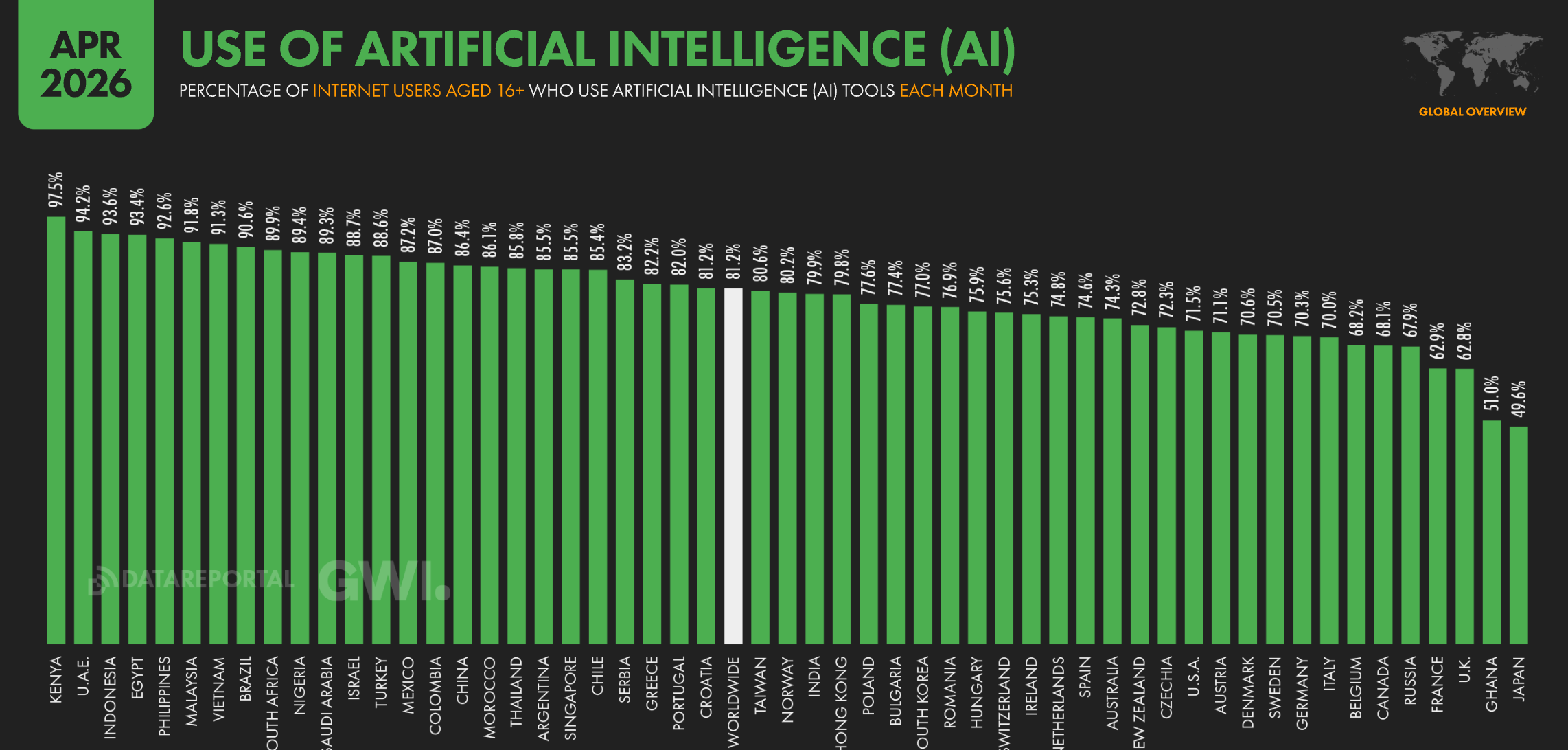
Kenya leads the world in AI tool adoption: 97.5% of internet users use AI tools every month. Source: Digital 2026 Mid-Year Global Update Report
Kenya has one of the most tech-forward populations on the continent, with many digitally savvy small businesses already operating online and actively looking for tools to grow. People here don't just know about AI. They use it. Freelancers use AI writing tools to serve international clients. SMEs use AI-generated product photos for their online shops. Developers build on top of LLMs. Marketing agencies test AI-powered ad creative.
But here's the part that matters for monetization: Kenyans adopt AI tools when those tools produce clear business outcomes. A tool that saves time, increases revenue, or reduces cost will get traction. A tool that's impressive but has no obvious return won't. This makes Kenya a great testing ground because you get signal fast. If Kenyans are willing to pay for your AI product, there's a real business there. If they're not, you'll find out quickly and can adjust before spending serious money on growth.
The payment infrastructure actually works
Kenya's payment ecosystem is one of the most developed in sub-Saharan Africa. M-Pesa is used by the vast majority of the adult population, and it's deeply integrated into everyday commerce. People are used to paying for digital services from their phones. They pay for streaming subscriptions, SaaS tools, cloud storage, and in-app purchases regularly.
This matters more than most companies realize. In many African markets, the biggest barrier to monetizing a digital product isn't demand. It's the payment step. Users want the product, but the checkout flow doesn't support how they pay, so they drop off.
In Kenya, that friction is lower. You can integrate M-Pesa through providers like Paystack or pawaPay, settle funds internationally if you need to, and start collecting revenue without setting up complex local payment infrastructure. The result is higher paid conversion rates compared to markets where online payments for digital products are less established. At Relatable, we saw this firsthand: conversion rates in Kenya were meaningfully higher than in Nigeria for the same product at comparable price points.
Purchasing power is real, not theoretical
There's a lazy assumption that gets repeated a lot in conversations about Africa: "low purchasing power." It's the kind of statement that sounds data-driven but leads to bad decisions.
Yes, average income in Kenya is lower than in Western markets. But that average hides a large and growing segment of professionals, business owners, and organizations with real budgets for tools that work. Kenya has a diverse economy with SMEs across every sector, a growing creative industry, enterprise companies, public and development organizations, and a vibrant startup ecosystem with funded companies actively looking for solutions and partners.
The question is not "can people afford it?" but "is your product worth paying for, at a price point that makes sense here?" If you price correctly and deliver real value, there are more than enough paying customers. Companies that arrive in Kenya with a blanket assumption about low purchasing power end up either not launching at all or pricing so low they trigger distrust. Both are mistakes.
Kenya is the best proxy for the rest of Africa
This is the most strategic reason to start in Kenya, and the one most companies miss.
South Africa is often treated as the "safe" launch market for Africa because it looks familiar on paper: higher GDP per capita, card payments work, English-speaking. But South Africa is actually an outlier on the continent. Its payment infrastructure, consumer behavior, and market dynamics are more similar to European markets than to the rest of Africa. If you build your product for South Africa, you'll likely need to rebuild significant parts of it when you try to expand into East or West Africa.
Kenya sits in a different position. The user behavior and customer preferences you'll encounter here are much more representative of the broader African market. Mobile money is the dominant payment method. Users are on Android phones with limited data. Trust signals matter. Onboarding needs to be fast and lightweight. If you can make your product work in Kenya, you can replicate that playbook in Tanzania, Uganda, Ghana, Rwanda, and beyond with relatively minor adjustments.
If you make it work in South Africa, you've made it work in South Africa. If you make it work in Kenya, you have a template for the continent.
The ecosystem supports fast launches
Kenya, and Nairobi specifically, has the infrastructure you need to launch quickly. There's a deep pool of tech talent if you need to hire locally. The startup ecosystem is active, with regular events, meetups, and communities where you can get your product in front of early users. Incubators, accelerators, and co-working spaces create natural distribution channels for new products.
For paid acquisition, Meta ads in Kenya are still affordable relative to most markets, with strong reach to decision makers and addressable customers. You can run meaningful tests and learn what creative, messaging, and targeting works without burning through a large budget. Compared to running the same campaigns in South Africa or Nigeria, the cost of learning in Kenya is significantly lower.
This combination of accessible talent, community, and affordable distribution means you can go from "testing the idea" to "live product with paying users" in weeks, not months.
How to actually do it
If you're reading this and you've got an AI product that solves a real problem, here's the practical path:
Start by putting your product in front of real users in Kenya who have never seen it before. Not a survey. Not a market research report. Actual user testing where you watch people try to use your product and listen to what they say. Do they understand what it does? Do they trust it? Would they pay for it?
Then localize the experience. Integrate M-Pesa. Adjust your pricing to reflect local value perception (test multiple price points, don't guess). Simplify your onboarding for mobile-first users. Add local trust signals.
Run a small paid acquisition campaign to validate that you can acquire users profitably. Test different channels: Meta, WhatsApp, local influencers, community partnerships. Find what works before scaling spend.
If the numbers make sense in Kenya, you have something. Take what you've learned and start expanding to the next market.
The companies that succeed in Africa are not the ones with the biggest budgets. They're the ones that picked the right starting point, learned fast, and built on what worked. Kenya gives you the best conditions to do exactly that.